IATF 16949 and Sample Approval: What the Standard Really Requires
IATF 16949 is the quality management standard for the automotive industry. It builds upon ISO 9001 and supplements it with industry-specific requirements. One of these requirements concerns the approval of products and manufacturing processes: Any company certified to IATF 16949 must demonstrate a procedure for approving components and processes prior to series production—in accordance with the specifications of the respective customer.
This is exactly where PPAP and PPF come into play. The standard does not specify which of the two procedures you must use. It requires that you use the procedure your customer specifies—and that you can document it.
What the Standard Requires—and What It Does Not
IATF 16949 specifies the requirements at the procedural level, not the form level. It requires a documented product and process approval process that meets customer-specific requirements. Manufacturers determine exactly what supporting documentation must be submitted, the scope of that documentation, and the format in which it is to be provided.
This results in a situation familiar to many suppliers: one plant, multiple customers, multiple validation requirements. One manufacturer requires PPAP according to AIAG, another requires PPF according to VDA Volume 2, and a third has its own additional requirements. The standard requires you to keep all of this under control.
PPAP, PPF, and EMPB—Who Requires What?
PPAP (Production Part Approval Process) originates from the AIAG standards and is widely used by North American manufacturers and their supply chains. PPF (Production Process and Product Approval) is the procedure defined in VDA Volume 2 and is standard practice in the German automotive industry. The Initial Sample Test Report (EMPB) is the documentation maintained for each individual component within these procedures.
Although the procedures differ in structure and scope of documentation, they share the same goal: to demonstrate that a component is produced using a process ready for series production and meets the agreed-upon requirements. The article “The Digitization of the PPF and PPAP Processes” explains how both procedures can be digitized.
What's New in Issue 2
IATF 16949 is being revised. In July 2026, the IATF announced that the second edition is scheduled for mid-2027; the end of the transition period is to be aligned with the transition period for ISO 9001. Specific deadlines have not yet been set.
The reason for the revision lies one level deeper: IATF 16949 is based on ISO 9001, which is currently being revised. Only once the new version of ISO 9001 is finalized can the IATF align its additions with it.
In practice, this means: There’s no need to rush, but now is a good time to take a look at your own approval process. Anyone who currently gathers their documentation from Excel files, email attachments, and collections of PDFs will have to gather it all over again every time a standard changes.
Why This Is a Digitalization Issue
The standard does not require the creation of a document. Rather, it requires demonstrating that a process is under control. The difference becomes apparent as soon as a customer asks: Which standard applied to this test? Which laboratory performed the measurements? Which subcontractor supplied the material—and what documentation did they provide?
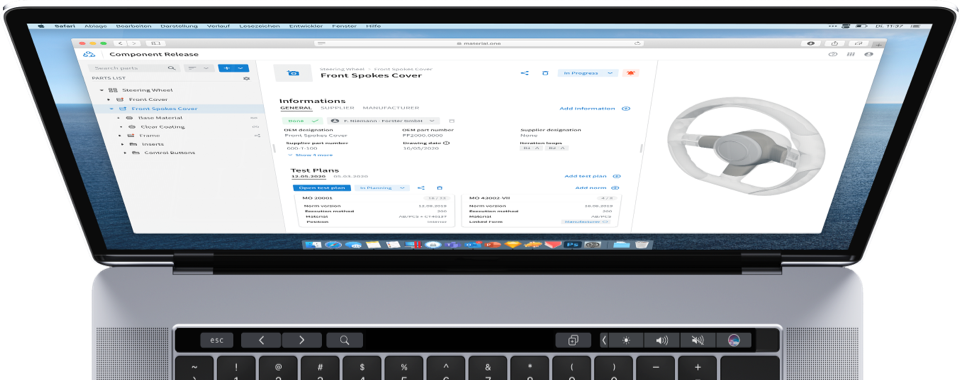
material.one brings this entire chain together in one place: digital standards as the basis for test planning, electronic feedback from laboratories, integration of subcontractors, and, as a result, the documentation required for PPAP and PPF. Not as a repository, but as an end-to-end process.
For more information:
Start today
We are happy to offer you a free live-demo of our apps and provide you with valuable advice